




Sinister and unknown events at midnight, sudden screams and then silence, what skulduggery is afoot?
The Garden of Paris first appeared in Weird Shadows from Beyond an anthology from 1965. Written by Eric C. Williams (1918-2010), who was involved with Fandom from the 1930s, beginning with Mr. Hazel's Miracle Carpet and The Venus Vein in Amateur Science Stories for December 1937. His first science fiction story was The Silent Ship (July 1965 New Worlds).
0 Comments
An unimaginable creature is unleashed on humans that has only one purpose which is to feed on everything, all the time.
Joseph Payne Brennan's story appeared in the March 1953 issue of Weird Tales. The Steve McQueen film The Blob released in 1958 (which Brennan successfully sued for copyright infringement), and a 1988 version were directly based on the story The film's tongue-in-cheek title song, "The Blob" (for the 1958 film), was written by Burt Bacharach and Mack David. It became a nationwide hit in the United States, peaking at #33 on the Billboard Hot 100 chart on November 9, 1958. It was recorded by a studio group who adopted the name The Five Blobs.
Your marriages vows are "until death do us part", but what if your dearly departed spouse, thinks those vows should be forever and ever?
May Sinclair was the nom de plume of Mary Amelia St. Clair (1863-1946), a British writer who wrote novels, short stories and poetry. She was an active suffragette and a spiritualist. Excerpt: "You know he was married twice. He adored his first wife, Rosamund, and Rosamund adored him. I suppose they were completely happy. She was fifteen years younger than he, and beautiful. I wish I could make you see how beautiful. Her eyes and mouth had the same sort of bow, full and wide-sweeping, and they stared out of her face with the same grave, contemplative innocence. Her mouth was finished off at each corner with the loveliest little moulding, rounded like the pistil of a flower. She wore her hair in a solid gold fringe over her forehead, like a child's, and a big coil at the back. When it was let down it hung in a heavy cable to her waist. Marston used to tease her about it. She had a trick of tossing back the rope in the night when it was hot under her, and it would fall smack across his face and hurt him." A place where wildlife is not found, but then you hear a stealthy movement in the underbrush, and you wonder what is there with you. And No Bird Sings is a short story by E. F. Benson, first published in Woman Magazine in December 1926. The story begins with a man visiting his friend who has recently inherited a country estate in Surrey. When he arrives at the local train station, the man decides to walk to his friend’s manor house. It’s a pleasant day, and the house is only about one mile away. The man’s route takes him through a dark and dreary wood, where he’s surprised by the lack of birds. Like the birds, his friend’s dogs won’t go in the wood either and it’s soon clear something evil is lurking there. Something that thrives in the darkness and sucks the blood out of rabbits.
A seemingly deserted house in the marshes, who or what then is making those sounds of footsteps you hear inside?
"A Tale of an Empty House" is a story by E. F. (Edward Frederic) Benson, first published in Hutchinson’s Magazine in June 1925. The story is set on the Norfolk coast in England, where the central character and his friend take shelter in the village of Riddington during a sudden downpour. They discover a derelict brick house and encounter the wrath of a ghostly limping man, a figure tied to the house's terrible past.
Trying to solve the mystery of a friend's disappearance could open a Pandora's box that once opened cannot be closed.
Author - Ray Bradbury Except: “The graveyard was at the top of the hill. It looked over all of the town. The town was hills - hills that issued down in trickles and then creeks and then rivers of cobblestone into the town, to flood the town with rough and beautiful stone that had been polished into smooth flatness over the centuries. It was a pointed irony that the very best view of the town could be had from the cemetery hill, where high, thick walls surrounded a collection of tombstones like wedding cakes, frosted with white angels and iced with ribbons and scrolls, one against another, toppling, shining cold. It was like a cake confectioner's yard. Some tombs were big as beds. From here, on freezing evenings, you could look down at the candle-lit valley, hear dogs bark, sharp as tuning forks banged on a flat stone, see all the funeral processions coming up the hill in the dark, coffins balanced on shoulders."
A big, old house at a bargain basement price, whatever you do don't go and inspect it after dark.
"Blind Man's Buff" is a ghost story by H. Russell Wakefield, first published in 1929. It is a chilling tale that centers on a man named Mr. Court who arrives at the isolated Lorne Manor late in the day, only to find himself trapped in a dark, disorienting house where the layout seems to shift and he is stalked by unseen, threatening presences.
Recovering from war time a man finds solace and healing in a remote inn in the French countryside, little does he know that something in the woodlands has chosen him to be their defender and emissary.
First published in Weird Tales, August 1926. Excerpt: "The trees had nursed him; soft whisperings of leaves, slow chant of the needled pines, had first deadened, then driven from him the re-echoing clamor of the war and its sorrow. The open wound of his spirit had closed under their green healing; had closed and become scar; and even the scar had been covered and buried, as the scars on Earth's breast are covered and buried beneath the falling leaves of Autumn. The trees had laid green healing hands on his eyes, banishing the pictures of war. He had sucked strength from the green breasts of the hills.Yet as strength flowed back to him and mind and spirit healed, McKay had grown steadily aware that the place was troubled; that its tranquility was not perfect; that there was ferment of fear within it."
Somewhere on an isolated moor, the line between the past and the present merge and when these two realities separate nothing can ever be the same again.
The Demoiselle D'Ys is a story in The King In Yellow by Robert W. Chambers. It's the fifth story in the book and arguably the first to have no connection to the titular character. Excerpt: "Standing the day before on the cliffs below Kerselec with Goulven, looking out over the sombre moors among which I had now lost my way, these downs had appeared to me level as a meadow, stretching to the horizon, and although I knew how deceptive is distance, I could not realize that what from Kerselec seemed to be mere grassy hollows were great valleys covered with gorse and heather, and what looked like scattered boulders were in reality enormous cliffs of granite. 'It's a bad place for a stranger,' old Goulven had said; 'you'd better take a guide;' and I had replied, 'I shall not lose myself.' Now I knew that I had lost myself, as I sat there smoking, with the sea−wind blowing in my face. On every side stretched the moorland, covered with flowering gorse and heath and granite boulders. There was not a tree in sight, much less a house. After a while, I picked up the gun, and turning my back on the sun tramped on again."
A forbidden book, that is seductive and alluring, and which ultimately sends an emissary to collect the soul of those who read its pages.
The Yellow Sign is a fictional symbol or glyph, first described in Robert W. Chambers' book The King in Yellow published in 1895. Its nature is unknown, but it seems to possess a strange siren call to the dark world of the King in Yellow and Carcosa, such that those who are exposed to it are doomed. The Yellow Sign's shape and purpose is never fully described, only that it is "a curious symbol or letter in gold. It was neither Arabic or Chinese, nor as I found afterwards did it belong to any human script." Anyone who possesses or sees – even by accident – a copy of the Sign is susceptible to some form of insidious mind control or possession, by the King in Yellow or one of his heirs. The stories also suggest that the original creator of the Sign was not human and possibly came from a strange alternate dimension that contains an ominous and ancient city known as Carcosa. A malevolent supernatural entity known as the King in Yellow, and a mysterious symbol called the Yellow Sign. The book and tales within it inspired H.P. Lovecraft to employ the use of only vaguely referring to his supernatural entities, and he included references to Chamber's book in one of his novels in the Cthulhu stories. In The Yellow Sign, a playboy artist and his model can't help falling for each other as symbols of death and decay press in from outside. The church watchman has a face like a maggot, and he scares both Mr. Scott and Tessie, along with Thomas, the bell boy. Moreover, both Mr. Scott and Tessie are haunted by bad dreams. Making matters worse, there's a play in Scott's library, The King in Yellow, that will make its readers go insane. And, Scott knows of the story of The Repairer of Reputations, in which someone was driven mad by the play. By the time Tessie gives him a black onyx pin with a gold symbol on it that she found in Battery Park, it's clear that something's gone horribly wrong. There is also a symbol known as the "Yellow Sign," which leaves the viewer susceptible to some sort of mind control. According to the works of H.P. Lovecraft's successor August Derleth, the actual performance of The King in Yellow is a summoning ritual for the Great Old One Hastur.
When a vampire claims you as his own, he will play guardian until the moment arrives that he transforms from savior to predator, and you know that you have been a victim all along.
"Dracula's Guest" is a short story by Bram Stoker, first published in 1914. The story concerns an unnamed young Englishman who is visiting Munich on his way to a meeting with Dracula in Transylvania. During a walk in the countryside, he has mysterious encounters with a beautiful woman asleep in a tomb and with a wolf. In 1914—, two years after Stoker's death—Florence Stoker, his widow and literary executor, published Dracula's Guest. In the book's preface, Florence wrote that it was an episode from "Dracula" that was excised due to the novel's length. David O. Selznick bought the film rights to Dracula's Guest in 1933 and later re-sold them to Universal Studios. Universal's film Dracula's Daughter (1936) was ostensibly based on the story, although it uses nothing from the plot.
Published in 1896, this story is known for its allegorical erotic fantasy featuring a female werewolf and its exploration of religious themes. The novel is set in a snowy landscape and focuses on the theme of blind love and the truth hidden behind appearances. H. P. Lovecraft praised the book for its gruesome tension and authentic folklore atmosphere. Critics often describe it as a minor classic in the werewolf genre and a melancholy tale that involves deep themes of life and death.
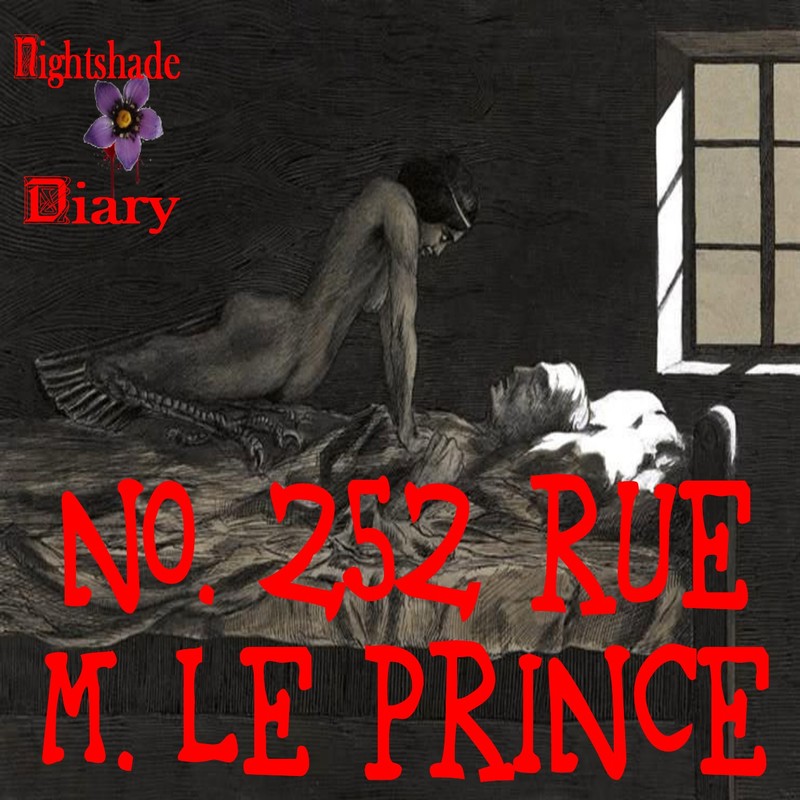
An ancient chateau named the Mouth to Hell, what could possibly go wrong spending a night there?
"No. 252 Rue M. le Prince" is a short story by Ralph Adams Cram, first published in the 1895. The story follows a narrator who visits his friend Eugene Marie d’Ardeche in Paris, who has inherited a house at No. 252 Rue M. le Prince from an estranged aunt known for practicing black magic. The house is rumored to be cursed, and d’Ardeche, along with some friends, decides to spend a night there to investigate. The story is set in Paris and features elements of gothic horror, including a haunted house, black magic, and an unsettling atmosphere.
A psychopath finds his perfect employment behind an executioner's hood, but even the most unremorseful have an Achilles' heel.
The short story "The Head Man" by Robert Bloch was first published in 1950. The story revolves around an S.S. executioner in Nazi Germany who becomes obsessed with keeping the heads of a couple charged with witchcraft. When it seems he may be prevented from obtaining them, he breaks the rules to get them, but things do not go as planned. |
Nightshade Diary Podcast MP3 FilesMarleneFrom the pages of Nightshade Diary come the haunting and hair-raising tales of ghosts, murder and mayhem. Who's hiding in the closet? What's under the bed? You'll be asking yourself these questions after you listen to these creepalicious tales that'll have you leaving the lights on when you go to sleep. Sources & Credits
Archives
January 2026
Categories
All
|


RSS Feed